
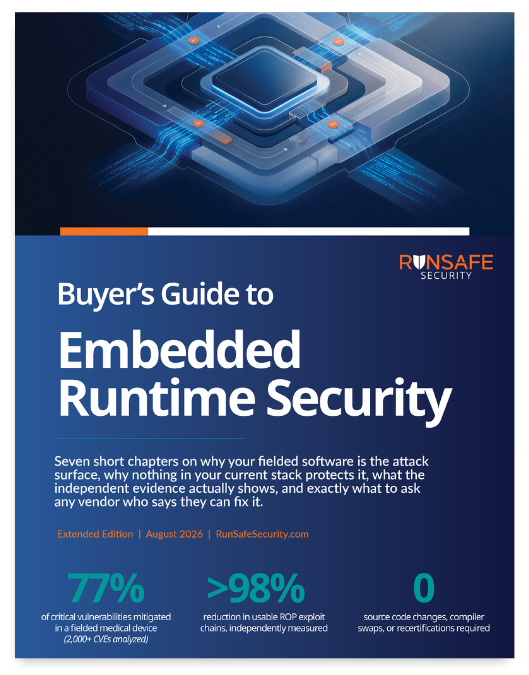
Buyer’s Guide to Embedded Runtime Security
Seven short chapters on why your fielded software is the attack surface, why nothing in your current stack protects it, and how to fix it.

In this Ebook, we will cover:
- What Embedded Runtime Security is and why the market is emerging now
- Why memory safety bugs are the majority of the serious vulnerability problem and what to do about it
- Why patch-first security strategies will not be able to keep up with the volume and pace of vulnerability discovery
- A vendor checklist with six questions for any ERS vendor
Why Embedded Runtime Security?
The industry once moved from antivirus to EDR because the old category no longer matched the threat. Analysts view ERS the same way, as a real category forming around a problem that the old ones cannot reach.
NSA and CISA already recommend runtime mitigation for code that cannot be replaced. The policy signal exists. The buying motion is catching up to it.


How RunSafe Delivers Embedded Runtime Security
The RunSafe Security Platform maps to the Identify, Protect, and Comply pillars of the broader Operational Software Assurance category that ERS falls within.
RunSafe provides build-time SBOMs for embedded builds, vulnerability identification and management, no-recompile runtime hardening, and evidence artifacts for regulators and program offices, such as for CRA, FDA 524B, and DoW SBOM readiness.